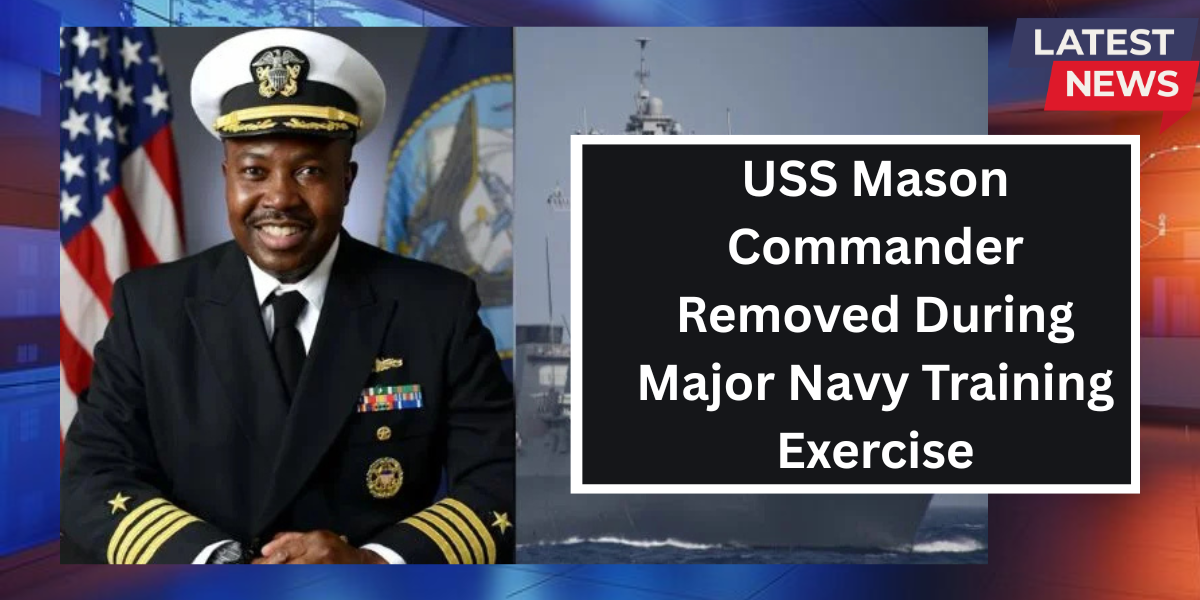
The U.S. Navy has removed the commanding officer of the guided-missile destroyer USS Mason. The decision was announced on February 13. The Navy said the reason was a “loss of confidence” in his ability to lead. While the statement was short and did not give many details, this type of action is serious in the military. Even though the ship will continue its mission, leadership changes like this can strongly affect the crew and the Navy as a whole.
What Happened on USS Mason?
Capt. Chavius G. Lewis was removed from his position as commanding officer of USS Mason (DDG-87). The decision was made by Rear Adm. Alexis T. Walker, who leads Carrier Strike Group 10.
The Navy did not explain the exact reason behind the action. Instead, officials used the standard phrase “loss of confidence.” This phrase is commonly used when senior leaders are relieved from duty. It does not always mean a crime was committed. It can include concerns about leadership, judgment, performance, or command climate.
After his removal, Lewis was temporarily reassigned to Naval Surface Group Southeast. Capt. Kevin Hoffman has now taken over as the new commanding officer of the ship.
The Navy also said that this change will not affect the ship’s current schedule or operations.
USS Mason Was in the Middle of COMPTUEX
At the time of the leadership change, USS Mason was taking part in COMPTUEX. This stands for Composite Training Unit Exercise. It is one of the most important training events before a Navy strike group deploys.
COMPTUEX tests ships in realistic and stressful war-like situations. Sailors train for air defense, missile threats, surface battles, and other complex missions. The exercise pushes the crew and leadership to perform at a high level.
When a commanding officer is replaced during such an important event, it can create challenges. A new leader must quickly understand how the crew is performing, how departments are working together, and what improvements are needed. All of this must happen while training continues.
What Does “Loss of Confidence” Really Mean?
In the Navy, “loss of confidence” is a serious statement. It means senior leaders believe the officer can no longer effectively command the ship.
However, it does not always mean criminal behavior. It can involve:
- Poor decision-making
- Leadership problems
- Failure to meet standards
- Issues related to discipline or morale
- Concerns about judgment
The Navy usually does not release detailed information in these cases. Officials say this protects privacy and allows for due process.
Even though the public may not know the full story, the phrase carries strong meaning within the military.
How Leadership Changes Affect the Crew
On a Navy destroyer, the commanding officer sets the tone for everything. This includes discipline, training, teamwork, and morale. Sailors look to the captain for direction and trust.
When a commander is removed, the crew may feel uncertain. Some sailors may see the action as proof that the Navy enforces high standards. Others may wonder what happened and feel uneasy.
A new commanding officer may have a different leadership style. That can lead to changes in priorities, expectations, and communication. Department heads and junior officers must quickly adjust.
Still, Navy ships are built for continuity. The executive officer and senior enlisted leaders help keep the mission on track. The Navy has systems in place to make sure operations continue smoothly even during leadership changes.
Why This Matters to the Navy
Commanding a destroyer is one of the highest responsibilities in a Navy officer’s career. It takes many years of service and experience to earn that position. Being removed from command can have a major effect on future career opportunities.
For the Navy as an institution, relieving a commander sends a clear message. Standards must be maintained. Accountability applies at every level.
In recent years, the Navy has placed strong focus on leadership quality, readiness, and professionalism. As global tensions increase, warships must be prepared for real-world missions. That preparation depends not only on advanced weapons and technology, but also on strong leadership.
The Mission Continues
Despite the leadership change, USS Mason remains fully mission capable. The ship continues its training under new command. Sailors will keep preparing for deployment and future operations.
Warships are designed to operate in changing conditions. Crews are trained to adapt quickly. While the removal of a commanding officer is a serious event, the focus now shifts to stability and performance.
In the end, this situation shows how important leadership is in the U.S. Navy. A captain is responsible not just for missions and equipment, but also for people. Trust, discipline, and accountability are key to success at sea. When trust is questioned, action follows. Now, under new leadership, USS Mason will continue training and working to meet the high standards expected of every Navy ship. The crew must stay focused and united. Over time, stability returns, routines settle, and confidence is rebuilt. That process shows the strength and resilience built into Navy culture and training.